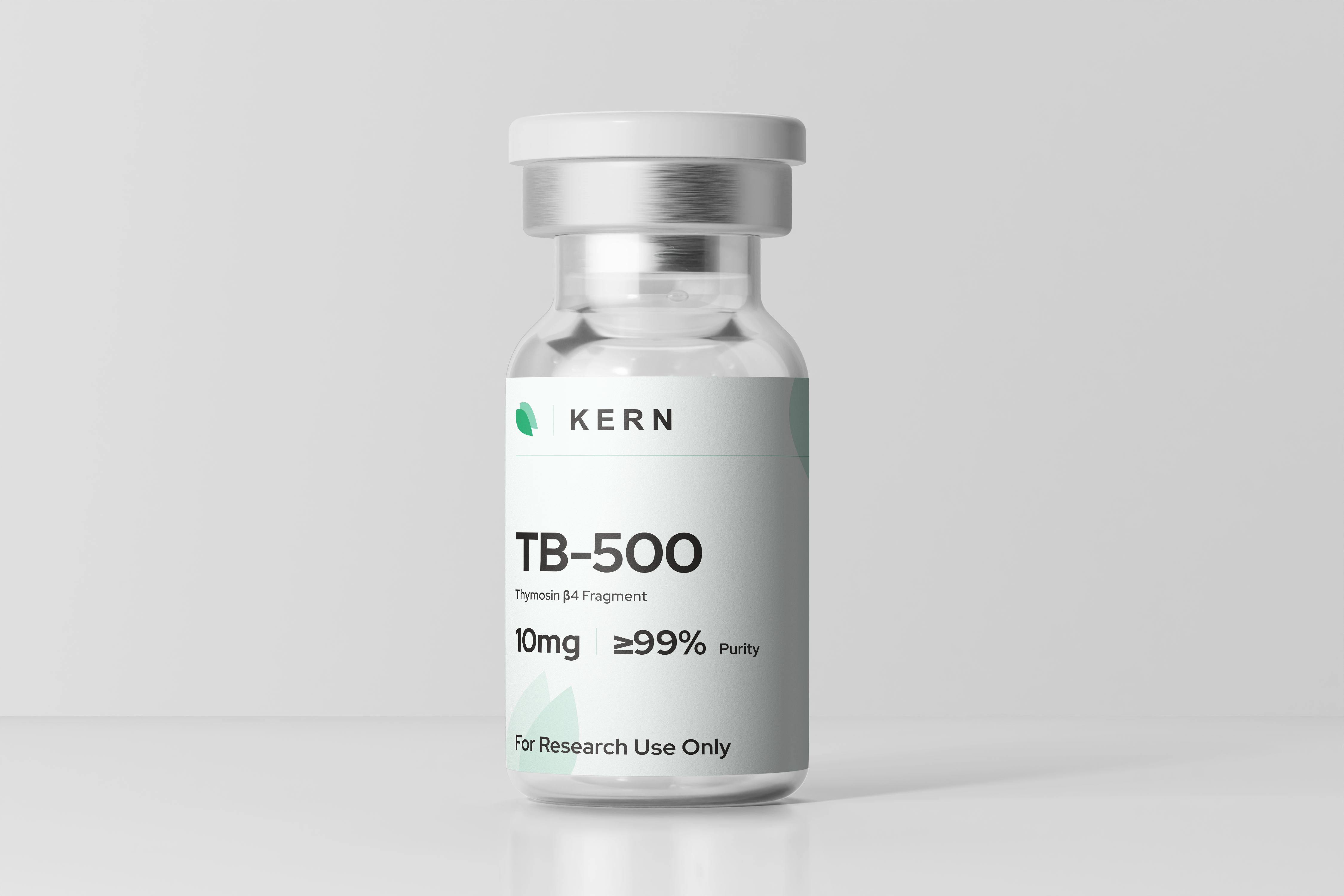
TB-500
Thymosin Beta-4 fragment. Naturally occurring peptide present in virtually all human and animal cells. Studied for tissue repair since the 1990s.
Select Dosage
Quantity
$202.24$208.50USD
Bundle & Save
Batch-Specific CoA
Third-Party Tested
Same-Day Shipping
We accept


Research Use Only. This product is intended for laboratory research purposes only. Not for human or veterinary use. Not for sale to minors.
01At a Glance01 / 08
TB-500 — Key Data
A snapshot of published research on TB-500. Each figure links to the literature summarized below.
Faster Healing
0Re-epithelialization at Day 7 vs saline controlFaster at Day 4
0Wound closure acceleration in full-thickness modelCell Migration
0Keratinocyte migration speed increase in vitroIL-8 Reduction
0Peak anti-inflammatory effect (p=0.0058)Corneal Damage
0TB4 dramatically reduced alkali burn severity02Mechanism02 / 08
How TB-500 Works
TB-500 (Thymosin Beta-4) is the principal G-actin sequestering molecule in eukaryotic cells. Its active site LKKTETQ (residues 17-23) drives cell migration and wound healing. The peptide is naturally present in wound fluid at 13 mcg/mL and is active at concentrations as low as 10 picograms. For research use only.
Discovered 1981500+ publicationsThymic tissue extract; first sequenced by Goldstein and Low
- 01
Actin Sequestration / Cell Migration
Primary- Binds G-actin at 1:1 molar ratio, regulating cytoskeletal dynamics
- 2-3x increase in keratinocyte migration within 4-5 hours
- Promotes endothelial cell migration to injury sites
- 02
NF-kB / Anti-Inflammatory Pathway
Primary- 61% reduction in IL-8 mRNA at peak (p=0.0058)
- Blocked NF-kB nuclear translocation in 50-60% of cells
- Suppressed IL-8 protein secretion at all timepoints (p<0.01)
- 03
Cardiac Repair (ILK-Akt)
Secondary- Activated integrin-linked kinase (ILK) for cardiac cell survival
- Improved ejection fraction at 14 and 28 days post-MI
- Prevented cardiac rupture and reduced scar volume
03Findings03 / 08
What the Studies Show
Peer-reviewed outcomes from published TB-500 research.
0
Full-thickness wound model at Day 7. Topical or IP administration vs saline controls. Improvement increased over time from 42% at Day 4.
Malinda et al., 1999Additional Clinical Outcomes
- 0Bock-Marquette et al., 2004
Post-LAD ligation in mice. TB4 treatment reduced scar volume at 28 days and prevented cardiac rupture over 5-week treatment. Published in Nature (2004).
- 0Sosne et al., 2023
4 of 6 patients fully healed at 28 days with 0.1% RGN-259 (TB4) eye drops. Remaining 2 patients healed by days 55 and 60. Neurotrophic keratopathy, compassionate-use study.
Wound Healing Speed Comparison
61% faster
TB-500 (Day 7)42% faster
TB-500 (Day 4)Baseline
Saline ControlFull-thickness wound model, topical or IP administration (Malinda et al., 1999)
04Applications04 / 08
Research Applications
Reported areas of investigation across the TB-500 literature.
- 01WOUND HEALING
Accelerated Tissue Repair
61% faster re-epithelialization at Day 7, with 11% greater wound contraction. Active at picogram concentrations.
- Re-epithelialization (Day 7)
- +61%
- Wound contraction
- +11%
- Keratinocyte migration
- 2-3x
Study finding. Wound closure improvement increased over time from 42% at Day 4 to 61% at Day 7.
Malinda et al., 1999 - 02CARDIAC REPAIR
Post-MI Cardioprotection
Activated integrin-linked kinase (ILK) for cardiac cell survival. Improved ejection fraction and reduced scar volume in mouse MI models. Published in Nature.
- Ejection fraction
- Improved at 14 and 28 days
- Scar volume
- Reduced at 28 days
Study finding. First demonstration of Tbeta4-ILK-PINCH complex formation promoting cardiac cell survival.
Bock-Marquette et al., 2004 - 03ANTI-INFLAMMATORY
NF-kB Pathway Suppression
Blocked NF-kB nuclear translocation in 50-60% of treated cells, suppressing pro-inflammatory cytokine production.
- IL-8 mRNA reduction (peak)
- 61%
- NF-kB translocation blocked
- 50-60% of cells
Study finding. Suppressed IL-8 protein secretion at all timepoints (p<0.01) across ELISA measurements.
Sosne et al., 2007 - 04CORNEAL HEALING
Corneal Repair and Protection
Dramatically reduced corneal opacification from 70% to 20% in alkali burn model. 100% eventual healing in human compassionate-use study.
- Corneal opacification (TB4)
- 20%
- Corneal opacification (control)
- 70%
- Human healing rate
- 100% (6/6)
Study finding. All 6 patients with neurotrophic keratopathy fully healed with 0.1% RGN-259 (TB4) eye drops.
Sosne et al., 2023
05Safety05 / 08
Reported Observations
- WADA banned substance (S2 category) -- performance enhancement acknowledged
- No serious adverse events reported in published preclinical literature
- Naturally present in human wound fluid at 13 mcg/mL
- Phase 2 clinical trials for corneal and wound healing completed without safety concerns
This summary reflects observations from published peer-reviewed research. It is not a comprehensive safety assessment. Researchers should review primary literature before designing protocols. For Research Use Only.
06Compound06 / 08
Compound Profile
Molecular Profile
What Is TB-500?
TypeSynthetic Heptapeptide (TB-500) / Endogenous 43-aa Protein (TB4)
CAS Number885340-08-9
Molecular Weight889.02 g/mol (TB-500 fragment)
Amino Acids7 (TB-500) / 43 (full Thymosin Beta-4)
SequenceAc-LKKTETQ (TB-500 active fragment)
FormulaC38H68N10O14
Storage & Handling
Stability Information
- Protect from light and moisture
- Keep in sealed container
- Avoid repeated freeze-thaw cycles
Lyophilized
Up to 2 years
Reconstituted
Up to 14 days
Working solution
Use within 24 hours
07Questions07 / 08
08References08 / 08
References
PubMed
Bock-Marquette et al., 2004
These references are provided for informational purposes. Kern is not affiliated with the authors or institutions listed above.
Related Products
Important Notice — Please Read
The statements made within this website have not been evaluated by the US Food and Drug Administration. The products we offer are not intended to diagnose, treat, cure, or prevent any disease. The peptides sold on this website are intended for research use only. The buyer is responsible for adhering to all local laws and regulations. Kern is not a pharmacy and does not provide medical advice or prescriptions. They are not for human consumption, are not FDA approved, and are not supplements or pharmaceutical drugs. The information provided on this website is for informational purposes and not a substitute for professional medical advice, diagnosis, or treatment. If you have questions or concerns about your health, please talk to your doctor. This site is an advertisement for education, research peptides, and not any specific medication. By purchasing from Kern, you confirm that you are a qualified researcher purchasing these compounds for legitimate in vitro or laboratory research purposes only. You must be 21 years of age or older to purchase.