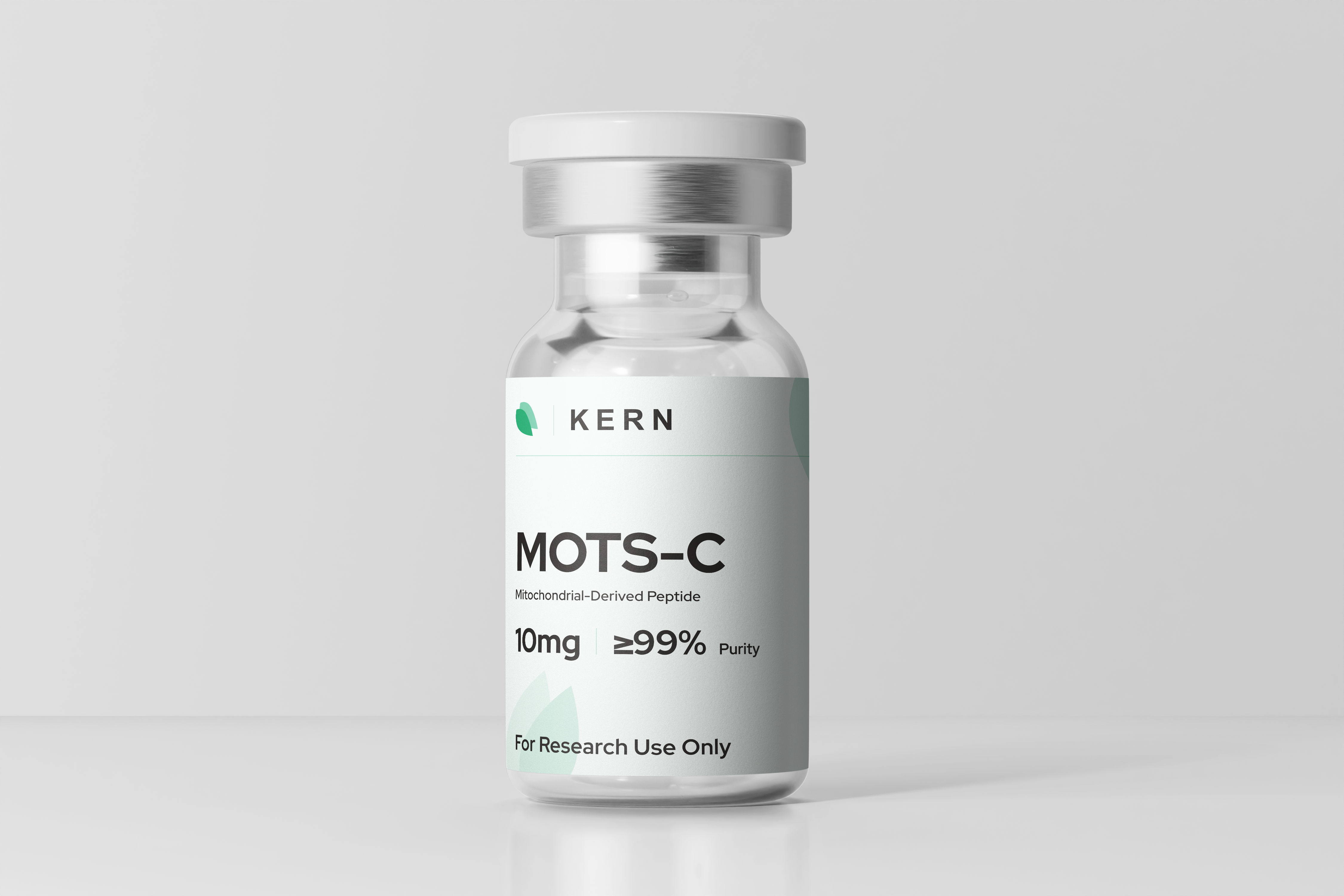
MOTS-c
Mitochondrial-derived peptide encoded by the 12S rRNA gene. Studied for metabolic regulation and cellular homeostasis.
Select Dosage
Quantity
$551.44$568.50USD
Bundle & Save
Batch-Specific CoA
Third-Party Tested
Same-Day Shipping
We accept


Research Use Only. This product is intended for laboratory research purposes only. Not for human or veterinary use. Not for sale to minors.
01At a Glance01 / 08
MOTS-c — Key Data
A snapshot of published research on MOTS-c. Each figure links to the literature summarized below.
Running Capacity
0Doubled in aged mice after 2 weeks (Reynolds et al.)Median Lifespan Extension
035% lower hazard ratio in late-life treatmentDecline by Age 70-81
0Endogenous plasma levels in human dataInsulin Sensitivity Restored
0Old mice restored to young mouse levelsMuscle Expression
0After exercise in human skeletal muscle02Mechanism02 / 08
How MOTS-c Works
MOTS-c is a mitochondrial-derived peptide encoded by the 12S rRNA gene. It functions as an exercise mimetic, activating AMPK through inhibition of the folate cycle and de novo purine biosynthesis. Endogenous MOTS-c levels decline 21% between ages 18-30 and 70-81, and increase ~12-fold in skeletal muscle after exercise. For research use only.
Discovered 201550+ publicationsEncoded by mitochondrial 12S rRNA gene (MT-RNR1); discovered by Changhan Lee lab at USC
- 01
AMPK Activation (Folate-AICAR)
Primary- Inhibits folate cycle and de novo purine biosynthesis
- AICAR accumulation activates AMPK
- MOTS-c translocates to nucleus in AMPK-dependent manner
- 02
Insulin Sensitivity / Metabolic
Primary- Prevented age-dependent and HFD-induced insulin resistance
- Insulin sensitivity of old mice restored to young levels in 7 days
- Improved glucose infusion rate and reduced hepatic glucose production
03Findings03 / 08
What the Studies Show
Peer-reviewed outcomes from published MOTS-c research.
0
22-month-old mice (human equivalent ~65+) treated with 15 mg/kg/day for 2 weeks. Running distance increased 2.16-fold. Effective across all ages tested.
Reynolds et al., 2021Additional Clinical Outcomes
- 0Reynolds et al., 2021
Late-life treatment starting at 23.5 months. 15 mg/kg 3x/week. Hazard ratio 0.654 (p=0.05). Maximum lifespan also increased ~7%.
Exercise Capacity Improvement
2.16x running distance
MOTS-c (Aged Mice)Baseline
Untreated Aged Controls2 weeks
Treatment Duration22-month-old mice (human equivalent ~65+), 15 mg/kg/day (Reynolds et al., 2021)
04Applications04 / 08
Research Applications
Reported areas of investigation across the MOTS-c literature.
- 01EXERCISE MIMETIC
Doubled Running Capacity in Aged Mice
15 mg/kg/day for 2 weeks doubled running distance in 22-month-old mice. Effective across all ages tested.
- Running distance increase
- 2.16x
- Treatment duration
- 2 weeks
- Mouse age
- 22 months (~65+ human)
Study finding. MOTS-c improved physical performance in aged mice that had already experienced significant age-related decline.
Reynolds et al., 2021 - 02METABOLIC HEALTH
Insulin Sensitivity Restoration
Old mice had insulin sensitivity restored to young mouse levels within 7 days. Prevented both age-dependent and high-fat-diet-induced insulin resistance.
- Insulin sensitivity restoration
- 7 days
- Age-dependent IR
- Prevented
- HFD-induced IR
- Prevented
Study finding. Improved glucose infusion rate and reduced hepatic glucose production in clamp studies.
- 03LONGEVITY
Late-Life Lifespan Extension
Started at 23.5 months (very late-life), yet achieved 6.4% median lifespan extension with a 35% lower hazard ratio.
- Median lifespan extension
- +6.4%
- Hazard ratio
- 0.654 (p=0.05)
- Maximum lifespan increase
- ~7%
Study finding. Late-life intervention (15 mg/kg 3x/week) demonstrates efficacy even when initiated at advanced age.
Reynolds et al., 2021
05Safety05 / 08
Reported Observations
- MOTS-c is a naturally occurring mitochondrial-derived peptide
- Endogenous levels increase ~12-fold in muscle after exercise (natural response)
- 21% decline in plasma levels between ages 18-30 and 70-81
This summary reflects observations from published peer-reviewed research. It is not a comprehensive safety assessment. Researchers should review primary literature before designing protocols. For Research Use Only.
06Compound06 / 08
Compound Profile
Molecular Profile
What Is MOTS-c?
TypeMitochondrial-Derived Peptide (MDP)
CAS Number1627580-64-6
Molecular Weight2,174.60 g/mol
Amino Acids16
SequenceMet-Arg-Trp-Gln-Glu-Met-Gly-Tyr-Ile-Phe-Tyr-Pro-Arg-Lys-Leu-Arg
FormulaC101H152N28O22S2
Storage & Handling
Stability Information
- Protect from light
- Avoid repeated freeze-thaw cycles
- Store in original sealed container
Lyophilized (powder)
up to 2 years
Reconstituted
up to 30 days
Working solution
Use within 24 hours
07Questions07 / 08
08References08 / 08
References
PubMed
Lee et al., 2015
PubMed
Lee et al., 2021
These references are provided for informational purposes. Kern is not affiliated with the authors or institutions listed above.
Related Products

Important Notice — Please Read
The statements made within this website have not been evaluated by the US Food and Drug Administration. The products we offer are not intended to diagnose, treat, cure, or prevent any disease. The peptides sold on this website are intended for research use only. The buyer is responsible for adhering to all local laws and regulations. Kern is not a pharmacy and does not provide medical advice or prescriptions. They are not for human consumption, are not FDA approved, and are not supplements or pharmaceutical drugs. The information provided on this website is for informational purposes and not a substitute for professional medical advice, diagnosis, or treatment. If you have questions or concerns about your health, please talk to your doctor. This site is an advertisement for education, research peptides, and not any specific medication. By purchasing from Kern, you confirm that you are a qualified researcher purchasing these compounds for legitimate in vitro or laboratory research purposes only. You must be 21 years of age or older to purchase.